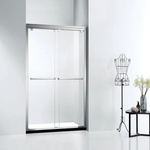
Dont buy A shower door unless you read this
A strong blog on this topic should help homeowners choose based on shower layout, budget, maintenance, bathroom style, and installation conditions—not simply declare one type universally better.
Framed vs. Frameless Shower Doors: Which One Is Better for Your Bathroom?

When planning a bathroom renovation, one of the biggest design decisions is choosing the right shower enclosure. Two of the most popular options are framed shower doors and frameless shower doors.
Both can provide excellent water containment and transform the appearance of a bathroom, but they are designed for different priorities. Frameless shower doors are often favored for luxury, modern bathrooms, while framed doors can be a practical and cost-effective choice for many everyday installations.
So, which one should you choose?
The answer depends on your shower opening, bathroom style, budget, wall conditions, and how much maintenance you are willing to do.
What Is a Framed Shower Door?
A framed shower door uses a metal frame around much or all of the glass enclosure. The glass is supported by aluminum or another metal framing system around the perimeter.
Because the frame provides much of the structural support, framed shower doors can generally use thinner glass than many frameless systems.
Typical framed shower-door components include the glass panels, perimeter frame, top and bottom tracks, handles, seals, and rollers or hinges depending on the design.
Framed systems are available as sliding doors, bypass doors, pivot doors, and other configurations.
What Is a Frameless Shower Door?
A frameless shower enclosure uses thick tempered safety glass with minimal metal around its perimeter.
Instead of relying on a large surrounding frame, the glass is supported using specialized hardware such as hinges, brackets, clamps, channels, support bars, or headers.
Many frameless shower doors use 3/8-inch or 1/2-inch tempered glass, depending on the design and engineering requirements.
The result is a clean, open appearance that allows the tile, stone, fixtures, and other bathroom finishes to remain visible.
The Biggest Visual Difference
The most noticeable difference is appearance.
A framed shower door creates a clearly defined enclosure because the metal framework outlines the glass.
A frameless enclosure creates a more transparent look.
With less metal interrupting the view, frameless glass can make a bathroom appear larger and more open.
This can be especially valuable in bathrooms with expensive tile or stonework because the enclosure allows the design behind the glass to remain visible.
Frameless is particularly attractive for:
Luxury bathrooms, modern bathrooms, large-format tile, marble showers, custom tile designs, open-concept bathrooms, and high-end renovations.
Framed doors work particularly well for:
Rental properties, budget-conscious renovations, standard-size shower openings, traditional bathrooms, and projects where affordability is the main priority.
Frameless Shower Doors Usually Provide a More Premium Appearance
If your objective is to create a high-end bathroom, frameless glass is usually the stronger design choice.
The visual simplicity of thick clear glass combined with minimal hardware creates the type of finish commonly seen in luxury hotels, spas, and custom homes.
Imagine spending thousands of dollars on beautiful marble or porcelain tile and then covering much of it with a heavy metal shower frame.
A frameless enclosure allows the tile to become part of the bathroom's visual experience.
For homeowners investing significantly in their bathroom renovation, this is one of the strongest arguments for frameless glass.
Framed Shower Doors Are Usually More Budget Friendly
One of the biggest advantages of a framed shower enclosure is cost.
Because the metal frame provides additional structural support, the glass may be thinner and the manufacturing and installation process can sometimes be less expensive.
For homeowners renovating several bathrooms or landlords upgrading rental units, framed doors can provide an attractive finished shower without the higher investment associated with custom frameless glass.
That does not mean framed shower doors are cheap-looking.
Modern framed and semi-frameless systems are available in finishes such as matte black, chrome, brushed nickel, and brushed gold.
A properly selected framed door can still look very attractive.
Which One Is Easier to Clean?
Frameless shower doors generally have an advantage here.
Because there are fewer metal channels and tracks around the glass, there are fewer places for soap residue, water, and dirt to accumulate.
A frameless panel can often be maintained simply by using a shower squeegee after bathing and performing periodic glass cleaning.
Framed systems contain more corners, tracks, seals, and metal surfaces that may require additional attention.
The bottom track of some sliding framed doors, for example, can accumulate soap residue and mineral deposits if it is not cleaned regularly.
For homeowners who prioritize easy maintenance, frameless glass can therefore be very attractive.
But Frameless Glass Requires Consistent Care
Frameless does not mean maintenance-free.
Because the glass is such a major visual feature, water spots and soap residue can be very visible.
Homeowners should ideally squeegee the glass after showering.
A simple routine of removing water after each shower can dramatically reduce hard-water buildup and keep the enclosure looking clear.
Glass with an approved protective coating may also be easier to maintain.
Which One Provides Better Water Containment?
This depends heavily on the particular shower design.
A framed shower enclosure can provide very effective water containment because the frame, tracks, and seals help create defined barriers around the opening.
Frameless systems intentionally minimize framing, which means installation measurements and shower design become extremely important.
A properly designed frameless shower can contain water extremely well, but details such as shower-head position, curb slope, door location, panel gaps, door sweep, and shower dimensions must all be considered.
For example, placing a powerful shower head directly toward the opening of a frameless door can increase the possibility of water escaping.
Good shower-door design therefore begins before the glass is manufactured.
Which Shower Door Is Best for a Small Bathroom?
Frameless glass is often an excellent option for small bathrooms.
The transparent enclosure allows your eye to see through the shower rather than visually stopping at a heavy frame.
This can make the bathroom appear larger.
A fixed frameless glass panel can be particularly effective for walk-in showers where there is enough room to control water without installing a full door.
However, in extremely tight spaces, the door-swing area must be considered.
A frameless hinged door needs enough clearance to open properly.
If space is limited, a sliding shower door may be a better solution.
Which Shower Door Is Best for a Tub?
Framed or semi-frameless sliding shower doors are very common for bathtub applications.
A sliding system does not require floor space for a swinging door.
This makes it practical for bathrooms where the toilet, vanity, or other fixtures are positioned close to the tub.
Frameless tub enclosures are also possible and can create a much more sophisticated appearance.
However, the condition of the tub, wall construction, opening dimensions, and waterproofing should be evaluated before selecting the system.
Which Shower Door Is Best for a Large Walk-In Shower?
For a large custom walk-in shower, frameless glass is usually my preferred option.
Large showers provide enough space to use substantial fixed panels, elegant hinged doors, and minimal hardware.
A frameless enclosure also preserves the open feeling of the shower.
For bathrooms featuring benches, niches, body sprays, rain shower heads, or decorative tile, frameless glass allows these features to remain visible.
Which Is Better for a Corner Shower?
Either system can work.
For a custom corner shower with premium tile finishes, frameless glass generally creates a more architectural appearance.
You can use a combination of fixed panels and a hinged door to create a clean glass enclosure.
For a standard corner shower where cost and water containment are the primary concerns, a framed enclosure can be a practical alternative.
The exact recommendation should be based on the shower dimensions and location of the fixtures.
Which Is Better for an Uneven Shower Opening?
This is an important consideration.
Bathroom walls are not always perfectly plumb.
Older homes can have walls and curbs that are noticeably uneven.
Framed shower systems may sometimes provide more adjustment during installation because the frame can help accommodate certain variations.
Frameless glass requires extremely accurate measurements because the glass is custom fabricated and tempered.
Once tempered glass is manufactured, it cannot simply be cut down on the job site like ordinary glass.
For a custom frameless enclosure, professional field measurement is extremely important.
Which One Uses Stronger Glass?
Frameless shower doors normally use thicker glass because the glass itself plays a larger structural role.
Common frameless glass thicknesses include:
3/8 inch — approximately 10 mm
and
1/2 inch — approximately 12 mm
Framed systems can frequently use thinner tempered glass because the surrounding metal provides additional support.
All shower-door glass should be appropriate safety glazing designed for the application.
What About Semi-Frameless Shower Doors?
There is also a third option.
A semi-frameless shower enclosure combines characteristics of both systems.
For example, the enclosure may have a frame around the perimeter but no metal frame around the actual moving door.
This creates a cleaner look than a fully framed shower while generally maintaining more framing than a completely frameless design.
Semi-frameless systems can be an excellent middle ground for homeowners who want a modern appearance without moving completely into a custom frameless enclosure.
Framed vs. Frameless Shower Doors at a Glance
| Feature | Framed | Frameless |
|---|---|---|
| Initial cost | Usually lower | Usually higher |
| Appearance | Traditional/defined | Modern/luxury |
| Glass thickness | Usually thinner | Usually thicker |
| Metal visibility | More | Minimal |
| Cleaning | More tracks and channels | Fewer areas to clean |
| Customization | Moderate | Excellent |
| Showcases tile | Good | Excellent |
| Measurement tolerance | Often more forgiving | Precise measurement critical |
| Small bathroom appearance | Good | Excellent |
| Luxury renovations | Good | Excellent |
| Rental/property upgrades | Excellent | Depends on budget |
| Walk-in custom showers | Good | Excellent |
So, Which One Is Better?
There is no single answer for every bathroom.
Choose a framed shower door when budget is a major consideration, you want reliable water containment, you have a standard-size opening, you are renovating a rental property, or you prefer a traditional enclosure.
Choose a frameless shower door when appearance is extremely important, you have invested in beautiful tile or stone, you want the bathroom to feel larger and more open, you want fewer frames and tracks to clean, or you are creating a luxury custom bathroom.
Consider semi-frameless when you want something between the two in both appearance and cost.
One Final Piece of Advice: Choose the Shower Door Before Finishing the Shower
One mistake homeowners frequently make is waiting until the bathroom is completely finished before thinking about the shower glass.
The shower enclosure should ideally be considered during the remodeling process.
Wall reinforcement may be required where heavy glass hinges will be installed. The shower curb should be properly pitched toward the drain. The shower head should be positioned so that it does not spray directly through the door opening. Tile edges, benches, half walls, and curbs can also affect glass measurements.
Planning the enclosure early can prevent expensive corrections later.
The Bottom Line
A shower enclosure is more than a piece of glass designed to keep water inside the shower.
It is one of the largest design elements in the bathroom.
For practical, economical applications, a quality framed shower door can be an excellent investment.
For homeowners seeking a clean, spacious, custom, and upscale bathroom, frameless shower glass is usually the premium choice.
The best enclosure, however, is the one that fits the shower correctly, complements the bathroom design, controls water properly, and matches the homeowner's budget and lifestyle.
Beautiful glass starts with the right design, accurate measurements, quality materials, and professional installation.
Newsletter
Recent blog
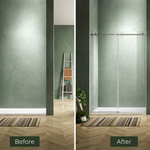
Installation of Glass Shower Door | NYC Guide | 66 Century
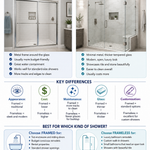
Dont buy A shower door unless you read this